
Common problems include
- Orders get misplaced or delayed
- Inventory levels become inaccurate
- Suppliers receive incorrect purchase quantities
- Customers experience delayed deliveries
- Businesses lose visibility into order status
Manage customer orders, supplier purchases, and inventory movement efficiently with a powerful order management system designed for small and growing businesses.
Our order management software helps businesses create sales orders, generate purchase orders, track order status, and automatically update inventory - all from a single platform.
Whether you run a retail business, wholesale distribution company, or B2B operation, this order management system software gives you complete control over incoming and outgoing orders.
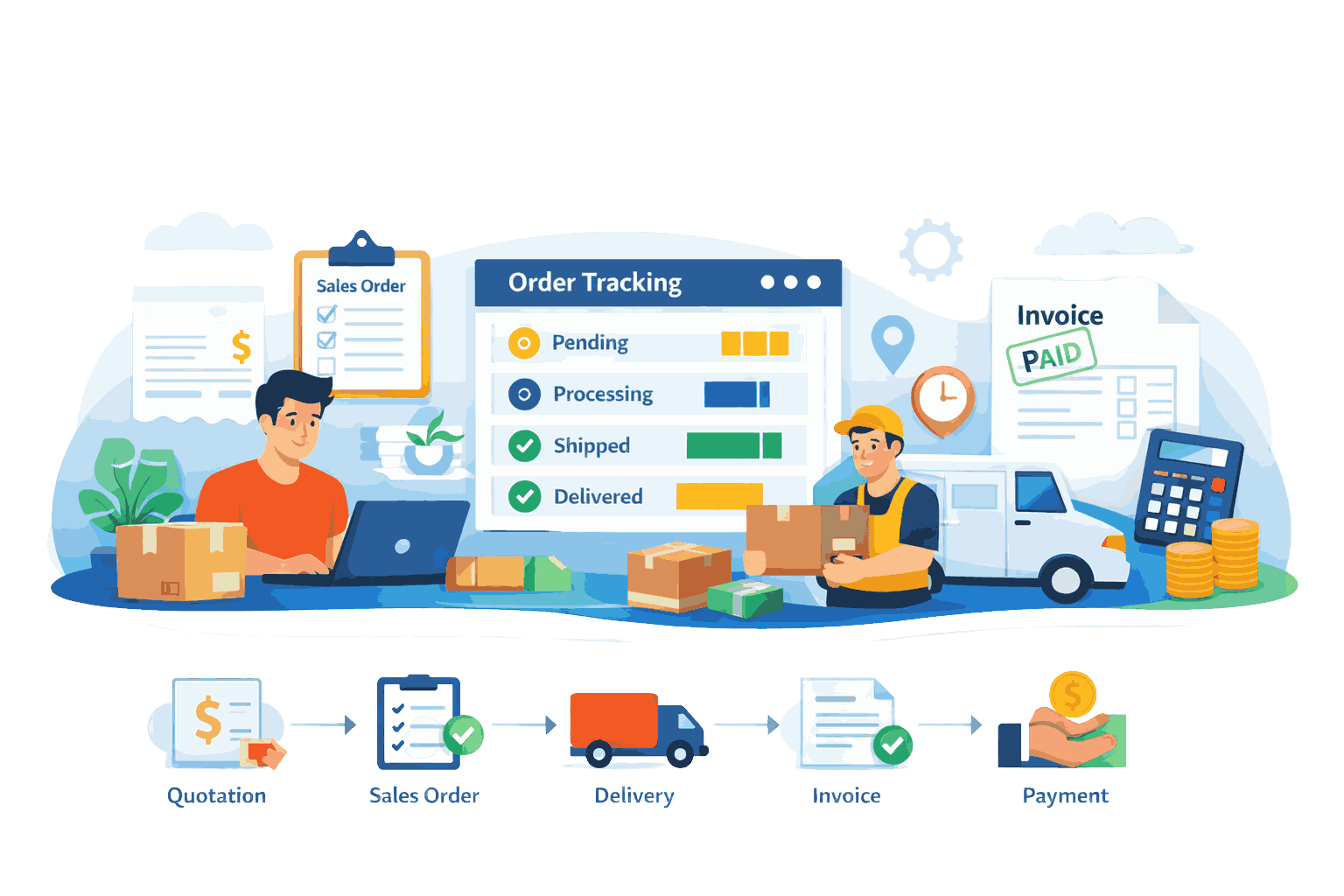
An order management system (OMS) is software that helps businesses track and manage the entire lifecycle of an order - from creation to fulfillment.
A modern order management system connects customer orders, sales processing, purchase orders, inventory tracking, supplier management, and order fulfillment.
With a reliable order management solution, businesses can avoid manual tracking, reduce errors, and improve operational efficiency.
Many businesses manage orders using spreadsheets or manual methods. As the business grows, this approach creates several problems.
Order management software solves these problems by centralizing order tracking and automating key workflows.
For small businesses, this means fewer mistakes and faster order processing.
Our order management software is designed specifically for small and growing businesses that want operational clarity without complex enterprise systems.
Create and manage customer orders easily.
Record customer orders before delivery, reserve inventory, track status until completion, and convert orders into invoices quickly.
Create purchase orders for suppliers, track incoming stock, monitor purchase history, and update inventory when goods arrive.
Purchase order management ensures the right products are ordered at the right time.
Every sales order and purchase order automatically updates inventory.
This ensures accurate stock levels, better demand forecasting, and reduced stock mismatches.
Record bulk customer orders, manage negotiated pricing, track repeat business clients, and monitor order fulfillment stages.
This makes it ideal for wholesalers and distributors.
Track pending orders, processing orders, completed orders, and cancelled or returned orders.
Clear visibility into order status improves customer communication and internal workflow.
Maintain supplier records, monitor purchase history, analyze vendor performance, and plan future procurement efficiently.
This helps businesses build stronger supplier relationships.
Manage orders using mobile phones, tablets, and desktop devices.
Review and manage orders even when you are away from the store or warehouse.
Keep sales and purchase order records organized in one place for faster retrieval and audit clarity.
This reduces confusion and improves team coordination.
Built for small and growing businesses that need performance without enterprise overhead.
Fewer manual errors, better visibility, and faster processing from one platform.
Implementing an order management system provides several operational advantages.
Understanding the difference helps businesses manage transactions effectively.
Sales Order: Created when a customer places an order with your business. It confirms products, quantities, and prices before the order is fulfilled.
Purchase Order: Sent to a supplier when your business needs to buy products. It records product details, quantities, and agreed purchase terms.
Both sales orders and purchase orders are critical for accurate inventory and financial tracking.
Small businesses often struggle with order tracking because they rely on manual processes or disconnected systems.
A proper order management system for small business provides structured order tracking, clear purchase planning, real-time stock updates, and organized order history.
This helps business owners focus on growth rather than operational confusion.
Order management software is useful for businesses that handle product orders regularly.
Any business that processes customer orders and supplier purchases can benefit from a structured order management system.
Order management becomes even more powerful when integrated with other business tools.
Our system connects order management with inventory management, POS billing, invoicing and accounting, customer records, and business reports.
Instead of managing multiple disconnected systems, businesses can operate everything from a single platform.
Designed for real-world operations with structured workflows and clear visibility.
This combination helps businesses reduce errors and improve speed.
A reliable order management system helps businesses streamline operations, reduce errors, and maintain complete visibility over orders and inventory.
If you are looking for an order management software solution designed for small businesses, this platform is built for real-world operations.
Track customer orders, supplier purchases, and fulfillment stages from one place with structured workflows and real-time updates.
Start managing your sales and purchase orders with a smarter system built for small and growing businesses.
Everything you need to know about order management software.
An order management system is software that helps businesses manage the complete order process, including creating sales orders, generating purchase orders, tracking order status, and updating inventory automatically. It helps businesses handle customer orders and supplier purchases in an organized and efficient way.
A sales order is created when a customer places an order with your business.
A purchase order is created when your business orders products from a supplier.
Sales orders track customer sales, while purchase orders track supplier purchases.
Small businesses need order management software to track orders properly, avoid stock mismatches, manage supplier purchases, and ensure timely order fulfillment. Without an order management system, businesses often face delayed orders, incorrect stock levels, and manual tracking errors.
Yes. A good order management system automatically updates inventory when sales orders are fulfilled and when purchase orders are received. This helps maintain accurate stock levels and prevents overselling or stock shortages.
Order management software is useful for retail stores, wholesalers, distributors, manufacturers, and e-commerce businesses that handle customer orders and supplier purchases regularly.
Order management software helps businesses process orders faster, reduce manual errors, improve inventory accuracy, track order status, and manage supplier purchases more efficiently.
Yes. Modern order management systems are designed specifically for small and growing businesses. They help small businesses manage orders, inventory, and suppliers without using complex enterprise systems.
Yes. Many modern order management applications allow businesses to create and manage sales orders and purchase orders using mobile devices, tablets, or desktops.
Order management software improves business operations by organizing orders, reducing manual tracking, improving supplier coordination, and providing clear visibility into order status and inventory levels.
You should look for features like sales order creation, purchase order management, inventory integration, order tracking, supplier management, reporting, and mobile access when choosing an order management system.
Move beyond spreadsheets and manual order logs. Manage sales orders, purchase orders, inventory, and reporting with one connected software platform.